Disclosure: This post contains affiliate links. As an Amazon Associate I earn from qualifying purchases. See our disclosure policy for details.
Florida has three winters, not one
A national “put the mower away” calendar fails in Florida because the state does not share one winter. North Florida (roughly the Panhandle through Jacksonville and Gainesville) gets real cold snaps, soil that stays cool for weeks, and warm-season turf that slows hard or goes semi-dormant. Central Florida holds longer growth windows, with St. Augustine still putting on leaf through mild stretches and only stalling after repeated nights in the 40s. South Florida, including Miami-Dade, Broward, and the Keys, rarely sees true dormancy; turf keeps growing at a reduced rate and still needs regular care.
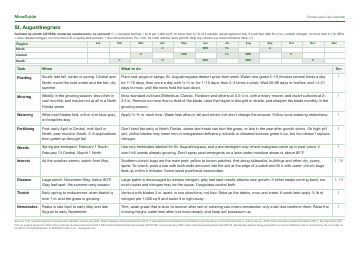
Printable full-year calendar
Print the full-year Florida schedule
It covers watering, feeding, weeds, insects, disease, aerating, and overseeding, month by month for each grass. Drawn from Florida extension publications. The bundle includes the planning worksheet.
That north-to-south split is the frame for every winter task below. Fertilizer timing, weed pressure, irrigation, and disease risk all change with how cold your nights run, not with a single statewide month label. Match the advice to your county’s pattern rather than to a map of the Lower 48.
The full month-by-month playbook for Florida grasses, soils, and county-level quirks lives in the Florida lawn care guide. This post is the winter slice of that schedule: feeding, weeds, water, and the cool-wet disease that shows up when nights drop.
Does Florida grass go dormant?
St. Augustine is the default residential grass across much of the state. In north Florida it often yellows and slows after several frosts, holding color in protected yards and thinning in open ones. In central Florida it stays greener longer and may only pause during the coldest weeks. In the south it keeps a slower canopy going most of the season. Semi-dormant St. Augustine still has living crowns and stolons; brown leaf tips are not the same as dead turf.
Bahia behaves more like a pasture grass under cold. It browns earlier in the north, holds seedheads longer if you stop cutting, and greener sections often mark higher spots that drain faster. Bermuda, common on athletic fields and some home lawns, goes fully dormant under sustained cold in north Florida and may stay patchy green in the peninsula. Zoysia sits between St. Augustine and Bermuda on cold response, browning in hard freezes and holding better under mild winters.
Recognition matters because dormant and semi-dormant turf do not take nitrogen the way summer turf does. Pushing a high-N feed onto stalled St. Augustine in January in Tallahassee wastes product and can stress the stand when growth resumes. Actively growing St. Augustine in Fort Myers in January still responds to a light, balanced program, which is why the same calendar month needs different inputs by region.
What changes when growth slows
Growth rate drops first. Blades elongate slower, recovery from foot traffic slows, and thin spots stay thin longer. Color often shifts from deep green toward olive or yellow-green, especially on St. Augustine after cold nights. That color change is normal physiology, not automatically a nutrient deficiency.
Traffic tolerance falls with growth. Kids, dogs, and carts leave lasting tracks on cool, wet St. Augustine more readily than they do in June. Route footpaths or temporary mats across high-use lanes if the lawn is soft after winter rain. Thatch does not vanish in winter; it just stops being masked by new top growth, so low spots and old scalping marks show more clearly.
Root activity continues longer than top growth in mild central and south Florida winters. That is why potassium-forward winter feeds can still help when nitrogen should stay low: roots are still working while the canopy is quiet. In north Florida, once soil stays cold, even root activity slows, and the job shifts to protection rather than push.
Mowing: do you still cut?
Yes, if the grass is still growing. North Florida yards may go weeks between cuts once nights stay cold and top growth stalls. Central and south Florida lawns often need regular mowing through winter, just less often than in summer. Cut only when leaf has elongated enough to remove a light amount; do not chase a summer height on stalled turf.
Leave height and frequency details to the dedicated schedule. The month-by-month guide for St. Augustine mowing in Florida covers how short to cut and how often by season. Pair that with the regional hub at Florida mowing for grass-type context across the state. On this page, the winter rule is simple: mow when growth requires it, keep the blade sharp, and skip cuts on frost-stiff or waterlogged turf.
Feeding through winter
Timing follows growth, not the bag’s generic “fall” label. In north Florida, the last meaningful feed usually lands in late fall while turf is still active, then you hold nitrogen through true slowdown. Central Florida can take a light winterizer into early winter if nights have not stacked cold weeks yet. South Florida lawns that keep growing may take a low-N, potassium-forward application deeper into the cool months when soil tests and county rules allow it.
Do not push high nitrogen onto dormant or semi-dormant St. Augustine. Soft top growth in cold, wet weather invites disease and does little for roots that are not demanding N. Favor low-N, potassium-forward formulas built for cool-season recovery on warm-season turf.
Winter rye overseeding is a Bermuda-lawn choice in some southern markets. It is generally discouraged on St. Augustine: rye competes during spring green-up and leaves a messy transition when the rye dies out. If your stand is Bermuda and you want a green winter carpet, that playbook belongs in the Florida book hub rather than as a default here.
For a granular winterizer that matches the low-N shape warm-season lawns need, Turf-Tone Fall Winterizer 8-0-5 Natural & Organic Lawn Food. Long fits the job. Apply at the label rate with a calibrated spreader, only while turf is still taking nutrients, and water in per the product directions.
In central and south Florida, where growth never fully stops, a liquid low-N option can supplement root development without a heavy nitrogen hit: Ultimate 3-18-18 NPK- Lawn Food Quality Liquid Fertilizer- Easy to. Keep it off fully stalled north Florida turf.
Before any winter application, check your county fertilizer ordinance. Many Florida counties restrict nitrogen and phosphorus on lawns during defined blackout windows, and those rules override a national bag schedule.
Winter weed watch
Cool-season annuals fill every gap St. Augustine leaves open. Poa annua (annual bluegrass) shows as light-green clumps with boat-shaped leaf tips and seedheads that appear while the lawn is still thin. Chickweed forms low mats in moist shade. Henbit brings square stems and purple flowers in late winter and early spring, especially on thin north and central Florida lawns.
Pre-emergent timing is the control point you can still influence. A fall pre-emergent aimed at winter annuals needs to land before those weeds germinate, which in Florida often means earlier than northern cool-season calendars suggest. For the decision framework on soil temperature and product windows, use when to apply pre-emergent herbicide. Spot-treat emerged winter weeds with a product labeled for your grass type; St. Augustine is sensitive to many broadleaf mixes, so read the turf species list on the label before you spray.
Hand-pull small patches after rain when soil is soft, and fix the thin spots that invited the weeds once growth returns. Winter weeds are a coverage problem as much as a chemistry problem.
Watering in cooler months
Cut frequency, not depth. Cool air and shorter days lower evaporative demand, so the same deep watering you used in August will keep soil wet too long in January if you run it on a summer timer. Aim for infrequent, thorough cycles that wet the root zone, then let the surface dry between events.
Morning dew and seasonal rain often cover part of the need, especially on the Gulf and Atlantic coasts. Check soil with a screwdriver or probe before you irrigate; if it slides in easily and comes up damp, skip the cycle. Many Florida utilities and water management districts tighten irrigation days in winter. Follow local day-of-week rules even when the lawn looks dry on top after a windy afternoon.
Watch low spots and poorly drained clay or compacted fill. Winter rain plus automatic irrigation is a common path into large patch. Raise heads that puddle, and shut off zones that sit wet for more than a day after a storm.
Large patch watch
Large patch (a Rhizoctonia disease active in cool, wet weather) is the winter fungus problem on St. Augustine and zoysia in Florida. It shows as yellow to brown circular or irregular patches, often with a smoky or orange-brown outer ring while the center thins. It favors mild days, cool nights, long leaf wetness, and lawns that stayed lush or over-nitrogen late into fall.
Cultural controls come first. Mow only when leaf is dry enough not to smear, avoid evening irrigation, improve airflow by thinning dense hedges at the lawn edge, and hold nitrogen while patches are active. Rake leaves and debris that keep the canopy wet. The humid-heat version of Rhizoctonia brown patch, and the cultural habits that limit it in summer, are covered in brown patch in humid heat. Winter large patch is a related seasonal expression with the same preference for wet leaf and soft growth; do not treat the two as one product recipe.
Fungicides are a category tool when cultural steps are not enough and a diagnosis is clear. Use a product labeled for large patch on your grass species, follow label rates and intervals, and skip cure claims. Chinch bugs are a warm-weather St. Augustine pest, not the driver of winter thinning; if you are seeing cool-season circles after wet weeks, look at fungus and drainage before you reach for an insecticide.
Back to the full Florida playbook
Winter care in Florida is a region-matched set of small adjustments: feed only while turf is active, watch cool-season weeds early, water less often, and catch large patch when nights turn wet and mild. North, central, and south yards will not share the same week on any of those tasks.
For the complete Florida schedule across seasons, grass types, and the book-length detail behind this winter cut, return to the Florida lawn care guide. For St. Augustine care through the rest of the year, see St. Augustine grass care for Florida and Texas.