When to Apply Winterizer Kentucky Bluegrass
Apply winterizer to Kentucky bluegrass and tall fescue once soil temperature holds below 55°F for several consecutive days, which in most of the Midwest lands between mid-September and mid-October. That single window covers both grasses because they’re both cool-season turf, but the exact week shifts by 2 to 3 weeks between the northern edge of the region (Minnesota, Wisconsin, Michigan) and the southern edge (southern Illinois, Indiana, Ohio). A soil thermometer reads the actual trigger; a wall calendar only estimates it.
That gap between calendar and soil is the whole reason winterizer timing trips people up. Get it right and the nitrogen goes into root and rhizome storage for next spring’s green-up. Get it early and you’re feeding leaf growth right before a hard frost knocks it back down.
If you want the full regional breakdown, timing for aeration and overseeding, and a month-by-month calendar built around actual Midwest frost data, the Midwest Lawn Care Guide covers the whole fall sequence in one place, not just the winterizer step.
Reading Soil Temperature Instead of the Calendar
Soil temperature, not air temperature, is what triggers a cool-season lawn to shift energy from top growth to root and rhizome storage. That shift is exactly what a winterizer application is trying to catch. Push the fertilizer too early, while soil is still warm, and the nitrogen goes into blades you’ll just mow off.
Take the reading at a 2 to 3 inch depth, in the morning before the sun has warmed the top layer, and take it in more than one spot in the yard if you’ve got shaded and sun-exposed areas. A basic soil thermometer or a probe-style digital model both work here; our soil thermometer picks breaks down which ones hold a stable reading long enough to be useful instead of drifting the second you pull them out of the ground.
Once soil holds at or below 55°F for 3 to 5 straight days, you’re in the window.
Kentucky Bluegrass and Tall Fescue Don’t Move Together
Kentucky bluegrass spreads by rhizomes and stores more energy underground going into winter than tall fescue does, which is a bunch-type grass with a shallower root system. Practically, that means bluegrass lawns tolerate winterizer slightly later in the window (closer to the mid-October end) because the rhizomes are still actively storing carbohydrates. Fescue benefits from being on the earlier side of the same window, since it’s relying more on crown and root density than on rhizome spread.
If your lawn is a bluegrass/fescue blend, which is common across the Midwest, split the difference and apply in the first half of October rather than optimizing for one grass over the other.
Reading the Bag: Nitrogen and Phosphorus
Winterizer bags aren’t interchangeable, and the numbers on the front matter more than the word “winterizer” printed above them. Look for a nitrogen ratio weighted toward slow-release or a blend of quick and slow-release forms, since a straight fast-release product front-loads too much of the feeding into the first week instead of carrying the lawn through dormancy.
Disclosure: this post contains Amazon affiliate links. MowGuide earns a commission on qualifying purchases made through these links, at no extra cost to you.
For a straightforward, widely available winterizer blend,
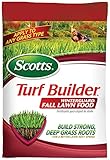 Scotts Turf Builder WinterGuard Fall Lawn Food, 10 lbs. — $18.59 covers the standard fall N-P-K ratio most cool-season lawns
need going into dormancy.
Scotts Turf Builder WinterGuard Fall Lawn Food, 10 lbs. — $18.59 covers the standard fall N-P-K ratio most cool-season lawns
need going into dormancy.
Phosphorus is the number to slow down on. Several Midwest states and
municipalities restrict phosphorus in lawn fertilizer outside of new
establishment or repair; check your state and local rules before buying, since
the restriction (and the exceptions to it) vary by location and change over
time. If you’re not actively establishing new grass or patching bare spots, a
zero-phosphorus winterizer, such as 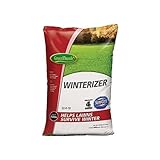 Green Thumb GT58105 Winterizer Lawn Fertilizer, 32-0-10 Formula, 5,000-Sq. Ft. Coverage - Quantity 1 — $33.45, sidesteps the
question entirely and is the safer default for an established lawn.
Green Thumb GT58105 Winterizer Lawn Fertilizer, 32-0-10 Formula, 5,000-Sq. Ft. Coverage - Quantity 1 — $33.45, sidesteps the
question entirely and is the safer default for an established lawn.
Organic and Slow-Release Options
If you’d rather feed the lawn without a synthetic quick-release component, organic winterizers built on composted poultry litter, feather meal, or similar slow-release nitrogen sources work on the same soil-temperature trigger as synthetic blends. The tradeoff is release speed: organic nitrogen depends on soil microbial activity to break down, and that activity slows as soil cools. Apply organic winterizer on the early side of your window rather than the late side, so the nutrients have time to become available before the ground goes fully dormant.
Pet-safe formulations exist in both the organic and synthetic categories if that’s a factor for your yard; our pet-safe lawn care roundup covers which fertilizer and weed control products carry that label and why.
Pairing Winterizer With Fall Repair Work
If your lawn came out of summer with bare or thin patches, get patch repair done before you winterize, not after. Winterizer is a maintenance feeding for established turf, and it isn’t formulated to support new seed germination the way a starter fertilizer is. Fill bare spots first with a patch product, let it establish, then apply winterizer once soil temperature hits the 55°F mark. Our guide to lawn patch repair products walks through which mixes germinate fastest in cooling fall soil.
For the rest of the fall sequence, including aeration and overseeding timing specific to Midwest grasses, the Midwest mowing and lawn care hub lays out the full month-by-month order of operations.
Applying It Right
Calibrate your spreader before you load it. A winterizer bag’s coverage rate assumes a specific spreader setting, and running a broadcast spreader wide open “to get it done faster” leaves stripes of over-fertilized turf next to under-fed gaps. Walk in straight, overlapping passes and water the lawn in afterward, roughly half an inch, so the granules dissolve into the root zone instead of sitting on top of the blades.
The Bottom Line for Midwest Lawns
Skip the calendar and trust the thermometer. Once soil holds at or below 55°F for a few consecutive days, sometime between mid-September and mid-October across most of the Midwest, that’s your window for both Kentucky bluegrass and tall fescue. Read the bag for nitrogen release speed and phosphorus content, get any patch repair done first, and water the application in. That single feeding is what carries the lawn’s root system through winter and into next spring’s green-up.