Disclosure: This post contains Amazon affiliate links. MowGuide earns a commission on qualifying purchases made through those links, at no additional cost to you.
Soil Temperature Is the Trigger, Not the Calendar
Kentucky bluegrass and tall fescue spend the fall building the root reserves that carry them through winter dormancy and into a strong spring green-up. A winterizer feeds that root growth directly, but only if it lands in the right window. Apply it too early and the lawn burns through the nitrogen on top growth instead of storing it. Apply it too late and cold soil locks the fertilizer out of the root zone before the grass can use it.
For Midwest lawns, that window sits later than most homeowners expect. The calendar says October, but the grass doesn’t read a calendar. It reads soil temperature, and the number to watch is 55°F at a 2-inch depth, measured consistently for several mornings in a row, not a single cold snap.
If you want the full month-by-month rundown for your part of the region, the Midwest Lawn Care Guide walks through the whole fall season, including where winterizing fits alongside aeration and overseeding. It covers the timing calls that shift by two or three weeks depending on how far north or south you are in the Midwest.
Pair the feeding schedule with your last few mows of the season too. The Midwest mowing guide covers the cutting height changes that should happen as growth slows heading into dormancy.
Kentucky Bluegrass vs. Tall Fescue: Different Clocks, Same Window
Both grasses respond to the same soil-temperature trigger, but they don’t store nutrients at the same rate. Kentucky bluegrass spreads by rhizomes and uses a fall feeding to thicken that underground network, which is where its spring recovery speed comes from. A well-timed winterizer on a bluegrass lawn shows up as faster, denser green-up in April.
Tall fescue is a bunch-type grass with a deeper, coarser root system. It doesn’t spread the way bluegrass does, so the fall feeding goes almost entirely into root depth and cold tolerance rather than lateral fill-in. Fescue lawns also tend to stay green later into the fall, which can trick homeowners into thinking the grass is still actively growing and skipping the feeding. It’s still building roots underground even after top growth slows down.
Mixed stands, which cover a lot of Midwest lawns, don’t need two separate applications. One properly timed winterizer serves both grass types since the trigger, soil temperature, is the same for each.
N-P-K Ratios for a Proper Winterizer
A true winterizer is not the same bag you used in spring. Spring formulas lean heavily on nitrogen (N) to push top growth and green color. A fall winterizer shifts the ratio toward potassium (K), the third number on the bag, because potassium is what improves cold hardiness and disease resistance heading into winter.
Look for a ratio in the 3-1-2 to 4-1-2 range, with the potassium number close to or higher than the nitrogen number. Phosphorus (the middle number) matters less here unless a soil test shows a deficiency, since phosphorus mostly drives root establishment in young or thin lawns rather than winter survival in an established stand.
A product like 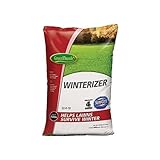 Green Thumb GT58105 Winterizer Lawn Fertilizer, 32-0-10 Formula, 5,000-Sq. Ft. Coverage - Quantity 1 ($31.95) is a
straightforward way to get a formula built for this window, instead of
digging through labels that are really spring blends with a snowflake
printed on the bag.
Green Thumb GT58105 Winterizer Lawn Fertilizer, 32-0-10 Formula, 5,000-Sq. Ft. Coverage - Quantity 1 ($31.95) is a
straightforward way to get a formula built for this window, instead of
digging through labels that are really spring blends with a snowflake
printed on the bag.
When to Apply: Reading Your Soil Temperature
Air temperature and soil temperature drift apart in the fall. The air can already feel like sweater weather while the top two inches of soil are still holding summer heat, especially under turf that had good sun exposure all season. That gap is exactly why a probe thermometer beats guessing from the forecast.
Check soil temperature at the same time each morning, about 2 inches down, in a spot that isn’t shaded by a building or fence line. A soil thermometer built for lawn use reads faster and more consistently than a kitchen probe repurposed for the yard. Once the reading holds at or below 55°F for three to five consecutive mornings, you’re in the window.
Across the Midwest that generally lands in mid-to-late October in the northern tier (Minnesota, Wisconsin, Michigan) and stretches into early November farther south (southern Illinois, Indiana, Missouri). Local elevation and tree cover shift that by a week or so in either direction, which is another reason to check your own soil rather than borrow a date from a neighboring state.
How to Apply Without Burning or Wasting Product
Winterizer is a granular product on nearly every Midwest lawn, and even distribution matters more here than with a spring feeding. Streaks or overlap in the fall show up as uneven green patches that stay visible all winter, since the grass isn’t growing fast enough to blend the mistake away.
Set your spreader before you start, not by eye halfway across the yard. Walking speed and spreader width both change the actual application rate versus what the bag label assumes. A spreader settings guide will get you close on the first pass instead of guessing and doubling back. Overlap your pass width by a few inches at the edges rather than trying to line up perfectly, and water the feeding in lightly if rain isn’t in the forecast within a day or two, so the granules reach the root zone instead of sitting on top of the thatch.
Common Fall Feeding Mistakes That Waste the Application
The most common mistake is applying by date instead of by soil reading. Homeowners who fertilize on Halloween every year regardless of conditions either waste product on grass that’s already dormant or push growth too late and leave the lawn softer going into a hard freeze.
The second is reaching for a spring bag out of habit. High-nitrogen, low-potassium spring blends push exactly the wrong kind of growth in October, leaving the lawn with more leaf tissue than it can support once temperatures drop hard.
The third is skipping the feeding on a fescue lawn that still looks green. Fescue’s visible color lags its actual growth stage in the fall, so a lawn that looks fine on the surface can still be past the ideal root-building window underground.
Get the soil temperature reading right, and the rest of the fall schedule, mowing height, aeration, and the feeding itself, falls into place around it instead of around a date on the calendar.